

With the introduction of artificial intelligence (AI), nearly every industry and sector is changing the way they used to work earlier. India is quickly embracing digital innovation and automation. This has led to the rise in demand for skilled AI professionals. This further has led to a tremendous rise in students looking for AI courses in India.
Today, some of the best AI courses in India are offered by some universities. These educational institutions have based their curriculum on practical learning, real-time projects, and emerging technologies. These emerging technologies include Machine Learning, Data Science, Robotics, and Deep Learning. Among the top AI colleges in India, K.R. Mangalam University stands out because it offers advanced artificial intelligence programmes. The university prepares students for futuristic careers in tech.
Choosing the best artificial intelligence course in India builds strong technical skills. It also opens doors to high-paying job roles in leading companies. With the right AI courses in India, students can shape a successful career in this field. In this blog, you will learn more about AI courses in India.
Why Choose AI Courses in India After 12th?
Artificial intelligence is one of the fastest-growing sectors in India. Companies in IT, finance, healthcare, education, cybersecurity, automobile, and e-commerce are already hiring AI professionals. This means students who start early gain a strong career advantage.
Top reasons to choose AI courses in India after 12th:
- High-demand industry with fast job growth
- Strong salaries and global job opportunities
- AI skill is needed in every field — from science to business
- Opportunity to work on real-world innovations like robotics, automation, and data science
Top AI Courses in India After 12th
Here are the most popular AI courses in India for students who have passed their 12th standard:
B.Tech in Artificial Intelligence & Machine Learning
This is one of the top AI courses in India and a perfect choice for students who are keen to learn advanced technologies.
What students learn in this course:
- Machine Learning
- Neural Networks
- Data Science
- Deep Learning
- Robotics & Automation
- Natural Language Processing
Who should choose it?
Students with PCM / PCMB who enjoy mathematics, coding, analytics and technologies.
B.Tech in Computer Science (AI & Data Science)
A popular choice among students because it combines software skills with AI expertise.
What students learn in this course:
- Programming
- Analytics
- Big Data
- AI-based Software Solutions
BCA (Artificial Intelligence)
Best AI course for students who want to enter IT and software development.
What students learn in this course:
- Python & Programming
- AI Tools
- Machine Learning Basics
- App Development with AI
This course is suitable for students from any stream with an interest in computers.
Also Read: Career and Scopes after BCA with Artificial Intelligence and Data Science
Best AI Colleges in India
While many institutions now offer AI courses in India, only a few provide modern labs, industry tie-ups and expert faculty.
Top features to look for in the best AI colleges in India:
- Updated curriculum
- Hands-on projects
- Internship opportunities
- Skilled faculty
- Placement support
- Smart labs & technology access
K.R. Mangalam University – A Good Choice for AI Courses
K.R. Mangalam University (KRMU) is one of the best universities offering top AI courses in India with real-world practical exposure and industry-orientated learning.
Students gain not only theoretical knowledge but also skills needed for future AI-focused careers.
What Makes KRMU Stand Out
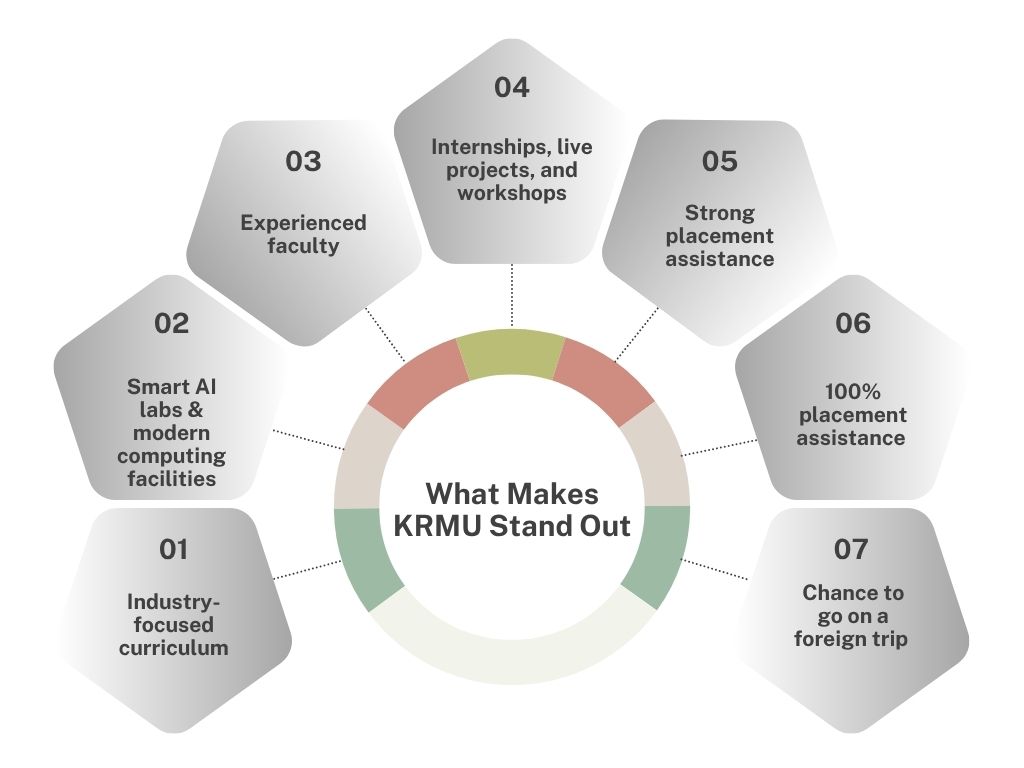
- Industry-focused curriculum
- Smart AI labs & modern computing facilities
- Experienced faculty
- Internships, live projects, and workshops
- Strong placement assistance
- Collaboration with tech companies
- 100% placement assistance
- Chance to go on a foreign trip
AI Courses Offered by KRMU
| Name of the Course | Course Duration | Eligibility | Fees/Year (In INR) |
|---|---|---|---|
| B.Tech. Computer Science and Engineering (AI & ML) with academic support of IBM & powered by Microsoft Certifications | 4 Years | 50% marks in 10+2 examination with Physics & Maths as mandatory course. For the remaining single course, select any course from Chemistry/ Computer Science/ Electronics/ Information Technology/ Biology/ Informatics Practices/Biotechnology/ Technical Vocational subject/ Agriculture/Engineering Graphics/ Business Studies/Entrepreneurship from any recognized Board/ University. | 2,65,000 |
| B.Tech. Computer Science and Engineering (Robotics & AI) with Academic Support of IBM & powered by Microsoft Certifications | 4 Years | Passed 10+2 examination with Physics and Mathematics as mandatory courses. For the remaining single course ,select any course from Chemistry/ Computer Science/ Electronics/ Information Technology/ Biology/ Informatics Practices/Biotechnology/ Technical Vocational subject/ Agriculture/Engineering Graphics/ Business Studies/Entrepreneurship from any recognized Board/ University with minimum 50% aggregate marks. | 2,50,000 |
| BCA (AI & Data Science) with academic support of IBM & powered by Microsoft Certifications | 3 Years | Passed 10+2 or equivalent examination from any recognized board/university in any stream with minimum 50% aggregate marks. | 1,65,000 |
| BCA (Hons. / Hons. with Research) AI & Data Science with academic support from IBM & powered by Microsoft Certifications | 4 Years | Passed 10+2 or equivalent examination from any recognized board/university in any stream with minimum 50% aggregate marks. | 1,65,000 |
| MCA (AI & ML) with academic support of IBM and powered by Microsoft Certifications | 2 Years | Any graduation degree with Mathematics at 10+2 level or at Graduation level with minimum 50% aggregate marks. | 1,50,000 |
Skills You Will Learn in AI Courses
AI courses in India build technical and analytical skills, including:
Machine Learning (ML)
Machine learning is the foundation of most AI applications. Professionals must understand a variety of methods to help computers learn from data and progressively improve their performance. These consist of reinforcement learning, supervised learning, and unsupervised learning.
AI Deployment and Cloud Computing
For training and deployment, AI models demand a large amount of processing power, which frequently calls for the usage of cloud platforms. Scalable infrastructure for data storage, processing power management, and AI solution deployment is offered by services like AWS, Azure, and Google Cloud.
Deep Learning (DL)
Deep learning is the process of solving complicated problems with sophisticated neural networks. It is crucial to understand topologies. They include recurrent neural networks (RNNs) for sequential data and convolutional neural networks (CNNs) for image processing. These abilities are essential for creating applications. They consist of sophisticated natural language processing tools, facial recognition, and driverless cars.
Robotics and Automation
Robotics greatly benefits from AI as it combines sensors, movement algorithms, and perception technologies. Owing to this combination, robots may now do various tasks. They include tasks like assisting with medical operations or independently constructing products on industrial lines. Students will get to understand both the software and hardware aspects of robotics. This enables them to design intelligent and adaptable systems.
Computer Vision (CV)
Information extraction and analysis from visual data, including pictures and videos, are part of computer vision. Face recognition software, augmented reality, and driverless car navigation are a few examples of applications.
Big Data Management
Large dataset management and analysis are crucial for AI applications. Tools like Hadoop and Apache Spark enable processing large volumes of data in distributed scenarios. NoSQL databases are also essential for handling complex AI operations since they provide flexible unstructured data storage possibilities.
Statistics and Mathematics
To comprehend and create AI algorithms, one must have a solid background in statistics and mathematics as well as computer programming. Neural networks and optimisation methods are supported by linear algebra and calculus, whereas data interpretation and predictive model construction depend heavily on probability and statistics.
Data Analysis and Visualisation
Successful model creation requires clean, interpretable data. That is why data analysis is at the core of artificial intelligence. To extract valuable insights, professionals in artificial intelligence-related fields like data analysis need to be able to clean, process, and analyse datasets. Python programming libraries like Pandas and Matplotlib, as well as visualisation tools like Tableau and Power BI, assist in presenting data in a way that promotes improved decision-making.
These are highly demanded skills that students will get after completing AI courses in India.
Career Opportunities After AI Courses

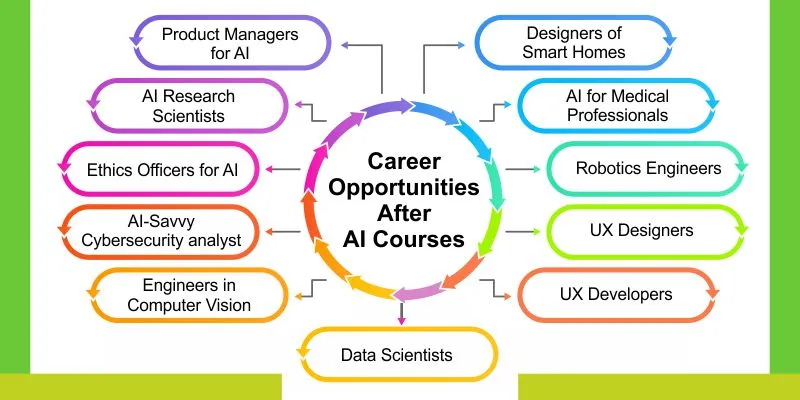
After completing AI courses in India, students can explore exciting roles, such as:
Product Managers for AI
Product managers for artificial intelligence are like any other product manager. In order to create and introduce a product, both positions serve as team leaders. Although it is an AI product in this instance, it functions similarly to other products in terms of managing teams, setting deadlines, and reaching goals.
Compared to most product management roles, this one has slightly greater technological requirements. To make an AI application available to their team, AI product managers must be aware of the components that go into creating it, such as the hardware, programming languages, data sets, and algorithms.
AI Research Scientists
Computer scientists that investigate and create novel AI methods and algorithms are known as AI research scientists. They work with other academics, create and test new AI models, publish research papers, and give talks at conferences. Programming is just one aspect of a research scientist’s work.
AI research scientists are an exception to the general rule that the IT sector is very welcoming to self-taught and untrained programmers. They must possess a solid grasp of statistics, mathematics, and computer science. They usually require graduate degrees.
Ethics Officers for AI
The ethical use of data used to create models will be a major problem in the future. To guarantee the appropriate development and application of AI, committed experts are required. Businesses may also consider forming an AI ethics council composed of staff members with a range of backgrounds and expertise, such as engineers, attorneys, ethicists, public officials, and business strategists.
They do ethical studies of AI projects and assist in creating ethical principles and policies for them. Any discoveries might be reported to the AI ethics committee. Critical thinking, good communication, and knowledge of AI frameworks and rules are among the abilities required for this role.
AI-Savvy Cybersecurity analyst
Intrusion detection is one area of cybersecurity where AI has found a place. Threat actors, however, also employ AI. In order to tackle problems like ransomware and other incursions, this area needs experts who are proficient in cybersecurity and have the know-how to use AI.
Engineers in Computer Vision
A developer with expertise in creating software that makes use of visual input sensors, algorithms, and systems is known as a computer vision engineer. These technologies, which include facial recognition and self-driving and self-parking automobiles, perceive their surroundings and respond appropriately.
Data scientists
Data scientists is a technology specialist who gathers, examines, and interprets data to address issues and inform organisational decision-making. Many of them build their own apps, although they are not always programmers. They mostly make use of analytical tools, big data, and data mining.
Businesses may enhance sales and operations, make better decisions, and create new goods, services, and policies by using data-driven business insights. They employ data visualisation to graphically represent study findings and predictive modelling to predict future occurrences, including customer attrition.
Designers of Smart Homes
Smart house designers will have a lot of chances as smart home technologies become more widely used. But this calls for more than just your typical HGTV fixer-upper host abilities. The planning, creation, and implementation of technological solutions that increase the house’s intelligence, connectivity, and automation are the areas of expertise for smart home designers. Customer demands, which differ from one customer to the next, house design and layout, technological integration in the home, automation, networking, and energy efficiency are all things they need to comprehend.
AI for Medical Professionals
Healthcare is one of the industries that mostly needs a bridge between the professional and technology sides. Although technology has numerous benefits for both patients and physicians, it is also one of the most delicate areas in terms of data protection.
AI has several potential applications in the medical field, including illness diagnosis and helping patients make important medical decisions by determining the optimal course of therapy. The robotics in the operating room that use AI to help with surgery are another instance of AI in healthcare.
Robotics Engineers
People who design, develop, and test software for robot operation are known as robotics engineers. In recent years, robotics has made great progress. Precision cancer surgical tools and automated house cleaners are a couple such examples. AI and machine learning may also be used by robotics engineers to improve the performance of a robotic system.
As a result, software developed by robotics engineers often relies on sensory input instead of human involvement. The hardware and software must be debugged by a robotics engineer to make sure everything is functioning as it should.
UX Designers
AI is used by UX designers to provide user experiences that are personalised and intuitive. Using AI approaches, they study user activity and enhance interface designs for efficacy and user satisfaction. Technical expertise and creativity are combined in this role, which calls for familiarity with AI-driven user insights and design software.
UX Developers
By adding functionality and engagement to digital products, UX developers make AI-enhanced user experience ideas a reality. They work together with designers and software developers to ensure seamless user interfaces. Proficiency in front-end programming and knowledge of AI integration are crucial for this position.
These are the career opportunities that graduates will get after completing AI courses in India.
Salary Scope in AI Careers
AI careers are among the highest-paying in India. Freshers can earn between Rs 4 and Rs 12 lakhs per year, and with experience, salaries grow even higher.
Conclusion
Artificial intelligence is transforming every sector in India. As industries adopt automation, machine learning, and data-driven decision-making, the demand for skilled AI professionals continues to rise.
Choosing AI courses in India after 12th can be beneficial. This is because they offer a strong competitive advantage, future-ready skills, and access to some of the fastest-growing career opportunities in the country.
To succeed in this field, students need hands-on learning, advanced labs, expert faculty, and real-world exposure. K.R. Mangalam University offers industry-focused AI courses in India. They are designed to build job-ready professionals. It does that through internships, live projects, innovative curriculum, and strong placement support. With a future-driven academic environment, KRMU helps students step confidently into the world of artificial intelligence and become leaders in tomorrow’s technology landscape.
Start your journey toward a high-growth AI career with K.R. Mangalam University.
Also Read: Career Opportunities & Scope of Artificial Intelligence
FAQs
Here are some of the most frequently asked questions to help you explore the best AI courses in India and choose the right path for your data-driven career.
What are the best AI courses in India?
Some of the best AI courses in India include B.Tech in Artificial Intelligence, B.Sc/BCA in AI & Data Science, M.Tech in AI, and specialised diploma or certificate courses in Machine Learning, Deep Learning, and Data Science.
Who is eligible for Artificial Intelligence courses?
For undergraduate AI courses, students usually need to pass Class 12 with Science/Maths. For certificates and diplomas, eligibility criteria are more flexible. Postgraduate AI courses require a relevant bachelor's degree.
Is AI a good career in India?
Yes. AI is one of the fastest-growing career fields. Industries such as IT, finance, healthcare, e-commerce, cybersecurity, robotics, and manufacturing are hiring AI professionals with attractive salary packages.
Which colleges are best for Artificial Intelligence in India?
Several universities offer top-quality AI programmes. K.R. Mangalam University is one such university that offers modern AI courses with industry-oriented curriculum, expert faculty, advanced labs, and strong placement assistance.