

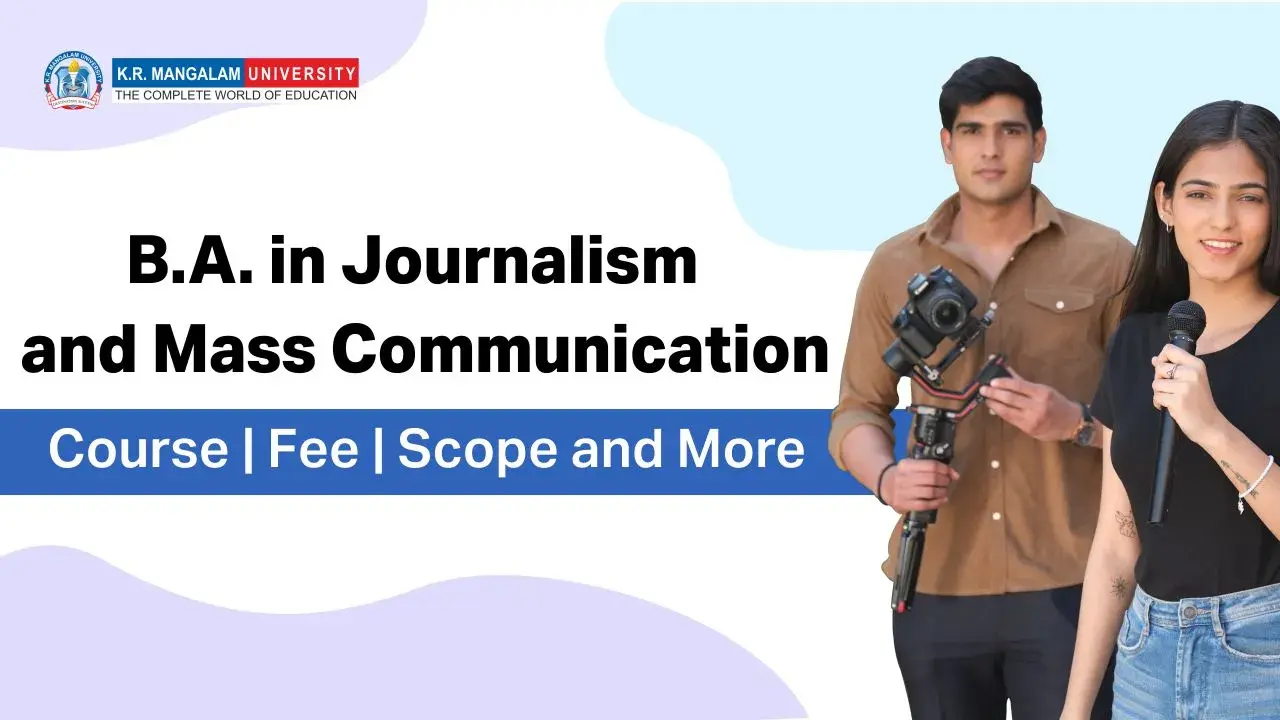
Journalism and mass communication are two closely related fields of study and practice. They both require a specific set of skills to create and disseminate the information that the masses can acquire and understand easily. Hence, the main objective of journalism and mass communication is to spread accurate and unbiased information. This field of study typically involves analysing, creating, presenting and reporting any important news or event. With the help of tools like newspapers, broadcasting, digital media, advertising, social media, etc., we have become interconnected and interdependent. This is where a professional degree like a B.A. in Journalism and Mass Communication comes into play. In this blog, we examine all course details, including the best college, admission syllabus, scope, fee structure and more.
What is a B.A. in Journalism And Mass Communication (Hons. with Research)?
B.A. in Journalism and Mass Communication, also popularly known as BJMC, is an undergraduate course designed to train students with the skills and knowledge needed to carve a career in journalism, mass communication and the media industry. The Hons. with the Research component of the degree further enhances the knowledge, conceptual understanding and engagement of a student with the field. BJMC is an essential bachelor’s programme which allows an individual to venture into related fields such as advertising, digital marketing, social media, public relations and more.
The key topics to study in a Bachelor in Journalism and Mass Communication (Hons. with Research) include journalism principles, media ethics, media literacy, radio programme production, television journalism and more. Students of BJMC get equipped with a variety of skills like excellent written and oral communication, research and analysis, media production, proficiency in using digital media tools and more. If you are still confused about pursuing a BJMC degree, check out the next section.
Why Choose B.A. Journalism and Mass Communication?
The rapid advancement of social media and communication technologies has significantly contributed to the expansion of sectors such as news broadcasting, film production, advertising, print media, and other related industries. So the demand for media and entertainment content is at an all-time high. There are a lot of reasons why students should pursue the BJMC course after completing their 12th grade. Some of these reasons are as follows:
- Career Opportunities: One of the biggest reasons why you must choose the BJMC degree is the excellent career opportunities this field offers to the graduates. From mass communication and journalism to digital marketing and advertising, there are plenty of excellent employment options open for candidates.
- Diverse Skills: Another important advantage of pursuing this course is acquiring a transferable skill set. This includes excellent written and verbal communication skills to clearly convey ideas, thoughts and information. The graduates also gain excellent research, critical thinking and problem-solving skills.
- Creative Mindset: With the growing influence of platforms like X (formerly Twitter) and Instagram, the demand for content creators and influencers has surged. Interestingly, those with a B.A. in Journalism and Mass Communication (BJMC) often produce more engaging and impactful content. The programme nurtures creativity, storytelling, and strategic thinking, enabling individuals to think beyond the conventional and craft content that truly stands out.
- Latest Trends: This course allows an individual to stay ahead of the latest trends and emerging technologies such as social media, streaming, data journalism, voice assistants, VR & AR integration and more.
- Positive Contribution: Journalism is considered a rewarding and satisfactory career option, as it lets individuals positively contribute to society and its people. They can empower people to make better-informed and educated decisions in life.
- Connections: The journalism profession thrives on connections, and BJMC helps in developing strong networking skills. Thanks to seminars, internships and site visits, candidates can create close connections with clients, peers, mentors and the public.
Which is the Best University for BJMC (Hons. / Hons. with Research )?
B.A. in Journalism and Mass Communication is a popular bachelor’s programme among students. More than thousand colleges and universities offer this programme. However, only a few credible universities offer BJMC (Hons. / Hons. with Research) course. With the added research aspect, the students have the opportunity to study a specialised curriculum.
K.R. Mangalam University is one of the best private colleges in the country. Recognised by the University Grants Commission (UGC), KRMU offers a 4-year B.A. (Hons. / Hons. with Research) Journalism and Mass Communication programme. The course primarily focuses on building research, innovation and entrepreneurship qualities among students. For further details like BJMC (Hons. / Hons. with Research ) eligibility criteria, duration, programme fee, syllabus, etc, check the tables below.
BJMC (Hons. / Hons. with Research ) Course Details at KRMU
| Course Name | B.A. (Hons. / Hons. with Research) Journalism And Mass Communication |
| Course Type | Undergraduate |
| Course Duration | 4 Years |
| Admission Eligibility Criteria | Passed 10+2 or equivalent examination from any recognised board/university in any stream along with a minimum of 50% aggregate marks. |
| Programme Fee Per Year | Rs.1,60,000 |
| Average Salary | 3-5 LPA |
| Career Options | Journalist, Reporter, Editor, Digital Media Strategist, Filmmaker, Content Creator, Radio Jockey, Social Media Manager, Public Relations Specialist |
BJMC (Hons. / Hons. with Research ) Admission Process
After carefully understanding the eligibility, you can follow the below-mentioned simple steps to get admission to the BJMC course at KRMU.
- Visit admissions.krmangalam.edu.in to commence the application process
- Submit the fee to complete the payment process
- Give the entrance test, K.R. Mangalam University Entrance Exam (KREE)
- Appear in the personal interview led by the faculty members
- Secure the admission offer after completing the above steps
- Get enrolled in the BJMC programme right away
BJMC (Hons. / Hons. with Research ) Syllabus
Get a semester-wise breakdown of BJMC subjects below.
Year 01
| Semester I | Semester II |
| Communication in Real World | Media Ethics and Laws |
| Reporting and Editing for Print | Digital Photography and Imagery (Lab) |
| Reporting and Editing for Print (Lab) | Media Literacy and Analysis |
| Graphic Design and Visualization | Minor II |
| Graphic Design and Visualization (Lab) | Open Elective – I |
| Computer Application in Media (Lab) | Value-Added Course |
| Minor I | Club/ Society Activities |
| Value-Added Course | Summer Internship – I |
Year 02
| Semester III | Semester IV |
| Film Appreciation and Cinema Studies | Advertising and Integrated Marketing Communication |
| Radio Program Production | Advertising and Integrated Marketing Communication (Lab) |
| Radio Programme Production (Lab) | Television Journalism and Production |
| Minor III | Television Journalism and Production (Lab) |
| Verbal Ability | Minor IV |
| Open Elective – II | Communication & Personality Development |
| Evaluation of Summer Internship – I | Open Elective – III |
| Community Service | Value-Added Course |
| Summer Internship – II |
Year 03
| Semester V | Semester VI |
| Communication for Development | Event Management |
| Public Relation and Corporate Communication | Event Management (Lab) |
| Digital Media Marketing | Global Media Scenario |
| Digital Media Marketing (Lab) | New Media Technology |
| Minor V | Minor VI |
| Arithmetic and Reasoning Skills-III | Project – I |
| Evaluation of Summer Internship – II |
Year 04
| Semester VII | Semester VIII |
| Communication Research | Media Business Management |
| Research Methodology | Minor VIII |
| Data Analysis Tools | Research Project |
| Research Publication and Ethics | |
| Minor VII | |
| Project -II |
Career Scope After BJMC (Hons. with Research)
You must have noticed a significant rise in news channels and content creation. This has created a lot of opportunities for BJMC students in media companies, advertising firms, radio and TV networks, etc. If you want to know about career options after completing this degree, we have listed popular job roles below.
- Journalist: A Journalist is a dedicated professional whose responsibilities include researching, gathering, analysing and reporting news through multitudes of outlets. Having the responsibility and power to facilitate public discourse, they also attend events, conduct interviews and verify facts.
- Radio Jockey (RJ): Radio Jockeys have the primary responsibility of entertaining and informing the listeners. By hosting radio programmes and conducting interviews with important figures, RJs keep the listeners engaged.
- Digital Media Strategist: A Digital Media Strategist develops and employs online marketing strategies to improve brand recognition and increase engagement. They also optimise content, create social media content, research the latest trends and manage everything cost-effectively.
- Content Creator: Content Creators produce engaging material to attract a wider audience. Thanks to their excellent storytelling and writing skills, they produce marketing copies to advertise the clients. They are also responsible for managing content calendars, promoting content and being aware of the latest trends.
- Public Relations Specialist: A Public Relations Specialist is a professional enhancing and managing their company’s image. They create and maintain a positive public image through branding, media relations, communication and more.
- Event Manager: Besides planning and facilitating an event, event managers have a responsibility to make sure everything goes smoothly within budget constraints. They collaborate with the vendors, staff and clients to manage every aspect of an event.
Conclusion
Many students after completing their 12th grade are fascinated by the journalism profession but have limited information about it. We hope this blog has clarified doubts and simplified the intricacies of the B.A. in Journalism and Mass Communication programme. This dynamic and diverse field equips students with a variety of skills required to have a successful and dynamic career ahead. Credible institutions like K.R. Mangalam University (KRMU) offer a curriculum which expertly blends theoretical teaching with practical lessons. So empower yourself by achieving a successful career after graduating from KRMU. Join KRMU today!
Frequently Asked Questions
Is journalism hard to study?
The difficulty level of journalism as a subject depends on the individual capabilities, knowledge, skill level, and interest. Generally, it is considered moderately challenging but requires dedication, practical knowledge and a creative mindset.
What is the scope of the B.A. in Mass Communication?
One of the biggest benefits of pursuing a B.A. in Mass Communication is that it opens various career paths. A graduate can venture into a variety of industries ranging from journalism and advertising to public relations and marketing.
What is the salary of a B.A. Journalism graduate?
The salary of a B.A. Journalism graduate varies according to the skills, experience and designation one possesses. The entry-level journalism graduate can demand a 3-5 LPA while an experienced professional can even earn up to 10 LPA.
Is journalism a stressful job?
Journalism can be considered moderately stressful as there are tight deadlines to abide by. A dedicated professional may feel the work pressure and have to work hard to maintain the quality and accuracy of their work.
Which university is best for a B.A. in Journalism and Mass Communication?
There are plenty of universities and colleges offering a B.A. in Journalism and Mass Communication programme. However, the best private university is K.R. Mangalam University which is located in Gurugram. Recognised by UGC, KRMU offers high-quality education with world-class facilities and top placements.
Also Read: The Future of a Career in Journalism and Mass Communication