


In recent years, business management courses have grown in popularity as more students choose to seek degrees in this area. This increase is caused by a number of variables, such as the expanding global economy, the demand for managers in the workplace, and the need for qualified professionals. This has led to the introduction of various innovative management courses, and one such course is the integrated program in management (IPM). This course is a combination of BBA and MBA.
This IPM is gaining popularity among those who want an early start in business and leadership roles, as it eliminates the need for separate entrance exams and multiple admissions later. Instead of pursuing a traditional BBA followed by an MBA, 12th-passed students can opt for this integrated management program for a seamless, continuous learning pathway.
One major reason for its rising demand is the time and cost efficiency. Completing both degrees in five years saves an entire year compared with pursuing them separately. Students also benefit from early exposure to internships, industry projects, and case-based learning, giving them a head start in the business world.
Moreover, IPM programmes offered by top institutions focus on holistic development, including communication skills, critical thinking, quantitative aptitude, and real-world business problem-solving—making graduates more confident and job-ready at an early age.
In this blog post, we will discuss the BBA MBA integrated program in management in detail.
What is an Integrated Program in Management?
An integrated program in management is a five-year undergraduate and postgraduate degree. It is a mix of a Bachelor of Business Administration (BBA) and a Master of Business Administration (MBA). It is for students who have just completed Class 12. 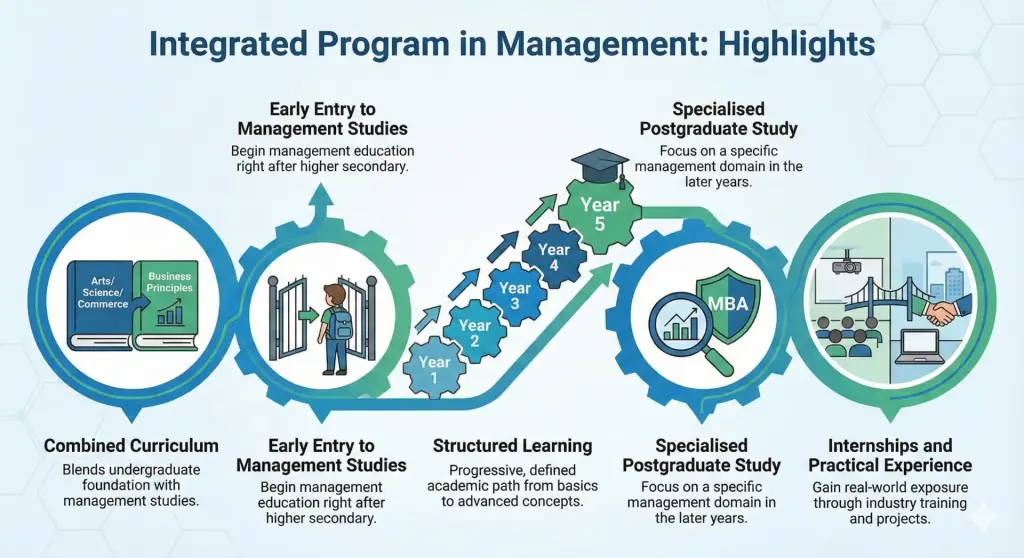
This structure provides a direct path to a management career after high school without requiring separate entrance exams for the postgraduate degree.
Admission
- Eligibility: Candidates must have completed their Class 12 or equivalent education.
- Entrance exams: Admission is often based on performance in an entrance exam, such as the Integrated Programme in Management Aptitude Test (IPMAT). Many colleges and universities also consider Class 12 marks.
Benefits of an MBA Integrated Course
Below are the benefits of an integrated program in management:
- Time and Cost-Efficient: Completing an integrated programme can save up to a year compared to traditional separate degrees. Also, it reduces costs by avoiding fees for separate applications and entrance exams.
- Seamless Learning: The curriculum provides a continuous learning path. This is because it covers both undergraduate business principles and advanced postgraduate concepts without any educational gap.
- No Entrance Exams: Students can bypass the need to prepare for and take a separate MBA entrance exam like the GMAT or CAT. Their admissions are based on their undergraduate performance.
- Earlier Career Start: Graduates can enter the professional world a year earlier. This means they get to start their careers in leadership roles sooner than their peers who pursue degrees separately.
- Stronger Career Prospects: The comprehensive and integrated curriculum can result in stronger placement opportunities with higher salaries. This is because employers value graduates with a long-term focus and a broad skill set.
- Time for Specialisation: Integrated programmes allow students more time to explore different business areas before choosing a specialisation. This will help them make a more informed decision about their career path.
- Enhanced Skills and Knowledge: The curriculum is designed to build skills in the right order, from basic business topics to advanced management concepts. That is why this curriculum prepares students for real-world challenges.
- Holistic Development: Students experience continuous exposure to leadership training, personality development, communication skills, and industry readiness. This ensures they grow not only academically but also professionally.
- Consistent Mentorship: Students remain in the same academic environment for five years. That is why they receive long-term mentorship from faculty, industry experts, and career counsellors who understand their strengths and aspirations.
- Industry-Focused Learning: Integrated programmes often include internships, live projects, case studies, and industry visits from the early semesters. This gives students practical exposure much earlier than traditional degree paths.
- Reduced Academic Pressure: Students don’t face the stress of preparing for additional entrance exams or switching institutions. The seamless structure allows them to focus entirely on building knowledge and skills.
Also Read: Integrated BBA MBA Course Details, Eligibility and Career options
Key Subjects and Curriculum of Integrated Program in Management
The curriculum of an integrated program in management is designed to build a strong foundation in business concepts. This structured progression ensures holistic development and prepares students to handle real-world business challenges with confidence.
Foundation Phase (Years 1–3: BBA Level)
In the initial years, students develop essential business knowledge and analytical skills through subjects such as:
- Principles of Management
- Microeconomics & Macroeconomics
- Business Mathematics & Statistics
- Financial Accounting
- Marketing Management
- Organisational Behaviour
- Business Communication & Soft Skills
- Business Law
- Human Resource Management
- Computer Applications in Business
Advanced Phase (Years 4–5: MBA Level)
During the final two years, students dive deeper into strategic and specialised areas of management:
- Strategic Management
- Corporate Finance
- Operations & Supply Chain Management
- Digital Marketing & Analytics
- Business Research Methods
- Entrepreneurship & Innovation Management
- Leadership & Team Management
- International Business Environment
- Data-Driven Decision Making
Specialisation Tracks
Students can choose their area of interest depending on career goals. They can choose specialisations such as:
- Marketing
- Finance
- Human Resource Management
- Business Analytics
- International Business
- Operations Management
- Entrepreneurship
Practical Learning Components
An IPM curriculum also includes industry-aligned experiential learning:
- Case studies & live projects
- Industry internships
- Capstone business projects
- Workshops with corporate professionals
- Business simulations & entrepreneurial labs
This blend of theoretical and practical learning ensures students graduate with strong managerial maturity and real-world readiness.
Career Scope After Integrated Program in Management
An integrated programme in management opens the door to a wide range of lucrative and future-orientated career opportunities. In this programme, students graduate with both BBA and MBA qualifications. That is why they enter the workforce with advanced managerial expertise, strong business acumen, and industry-ready skills. This makes IPM graduates highly valued across multiple sectors.
Corporate Management Roles
IPM graduates can work in key managerial positions across industries such as IT, retail, banking, consulting, and manufacturing.
Career options:
- Business Development Manager
- Operations Manager
- Marketing Manager
- HR Manager
- Project Manager
Marketing & Branding Careers
With expertise in consumer behaviour, digital marketing, and brand strategy, students can enter dynamic marketing fields.
Career options:
- Brand Manager
- Digital Marketing Strategist
- Market Research Analyst
- Social Media Manager
Finance & Banking Sector
The programme’s strong finance curriculum helps students build careers in financial markets, corporate finance, and banking.
Career options:
- Financial Analyst
- Investment Banker
- Credit Analyst
- Treasury Manager
- Risk Analyst
Human Resource & Talent Management
Companies seek skilled HR professionals to manage workforce planning and organisational growth.
Career options:
- Talent Acquisition Specialist
- HR Generalist
- Learning & Development Manager
- Compensation & Benefits Analyst
Consulting & Business Advisory
With strong analytical and problem-solving abilities, IPM graduates fit well in consulting firms.
Career options:
- Business Analyst
- Strategy Consultant
- Management Consultant
Entrepreneurship & Start-Ups
The programme encourages creativity, innovation and risk-taking, making it ideal for students planning to start their own venture.
Possible paths:
- Launching a start-up
- Family business expansion
- Freelance business consulting
Data & Business Analytics
Students with interest in analytics can pursue roles in business intelligence and data-driven strategy.
High-demand roles:
- Business Analyst
- Data Analyst (Management Track)
- Insights Manager
International Career Opportunities
The dual-degree advantage makes graduates eligible for many global career tracks, especially in multinational companies.
Roles abroad include:
- Global Project Coordinator
- International Marketing Executive
- Business Operations Associate
Academic & Research Opportunities
Students inclined toward teaching or research can pursue:
- Teaching roles in universities
- Research positions in think tanks
BBA MBA Integrated Course Colleges: How to Choose?
Choosing the right BBA MBA integrated course college after Class 12 is one of the most important decisions for your future career. While searching online, students will find many of the best integrated MBA colleges in India. This makes choosing the right college for themselves difficult. Here are the key factors you must consider:
Accreditation & University Reputation
Ensure the university is recognised by UGC and has a strong academic reputation. A well-established institution guarantees quality education, experienced faculty, and credible degrees that are valued by employers.
Curriculum & Specialisations Offered
A good integrated program in management should include both foundational BBA subjects and advanced MBA-level coursework.
Look for colleges offering specialisations such as:
- Finance
- Marketing
- HR Management
- Entrepreneurship
- Business Analytics
- International Business
This helps you tailor your learning toward your career goals.
Faculty Expertise
Experienced faculty with industry and academic backgrounds can significantly enhance your learning experience. Check whether the university features PhD scholars, industry experts, and global visiting faculty.
Industry Exposure & Internships
A top BBA MBA integrated college must offer:
- Industrial visits
- Summer internships
- Live industry projects
- Corporate workshops
- Guest lectures from business leaders
This exposure helps students build practical managerial skills.
Placement Records & Corporate Ties
Review the university’s placement statistics, partner companies, and the highest/average salary packages. Strong corporate connections ensure the best career opportunities after graduation.
Infrastructure & Learning Environment
Evaluate whether the campus offers:
- Libraries
- Smart classrooms
- Entrepreneurship cells
- Modern learning facilities
- Business labs & incubation centres
A supportive learning environment promotes creativity and innovation.
Global Exposure Opportunities
Many top colleges offer international
- Exchange programmes
- Summer schools
- Internships
- Workshops
Global exposure helps you stand out in the competitive business world.
Fee Structure & Scholarships
Compare the fees of different colleges and check for:
- Merit-based scholarships
- Need-based financial assistance
- Early bird benefits
This ensures the programme fits your budget while maintaining quality education.
Campus Life & Extra-Curricular Activities
Choose a college that promotes holistic development through:
- Clubs and societies
- Cultural events
- Sports facilities
- Leadership opportunities
These experiences build communication, teamwork, and problem-solving skills.
Student Reviews & Alumni Network
Check honest student testimonials and alumni success stories. A strong alumni network reflects the real-world impacts of the programme and helps open professional doors.
Integrated Program in Management at K.R. Mangalam University
K.R. Mangalam University (KRMU) offers a well-structured integrated program in management. It is designed for students who want to begin their management journey right after Class 12. The programme combines foundational business knowledge with advanced managerial skills, giving students a strong head start in the corporate world.
At KRMU, learners benefit from a future-orientated curriculum, industry-linked training, and hands-on exposure through real business projects. The university follows an outcome-based education model where students develop critical thinking, leadership qualities, communication skills, and analytical abilities—all essential for modern management careers.
KRMU also ensures strong practical learning through:
- Corporate internships every year
- Case studies and simulations
- Guest lectures by CEOs and industry experts
- Entrepreneurship and innovation support via incubation centres
- Workshops on digital tools, AI in business, data analytics, and financial modelling
Students gain access to global exposure programmes, international collaborations, and exchange opportunities, making learning more holistic and globally relevant. Along with this, the university offers excellent placement support, helping students secure roles in top companies across various industries.
Integrated Management Program at KRMU: Highlights
| Name of the Course | Eligibility | Course Duration | Yearly Fees (In Rs) |
|---|---|---|---|
| Integrated BBA+MBA with academic support of IBM | Passed 10+2 or equivalent examination from any recognised board/university with minimum 50% aggregate marks. | 5 Years | 2,30,000 |
Overall, K.R. Mangalam University’s integrated program in management is ideal for students who want a seamless learning pathway from undergraduate to postgraduate studies, with strong academic support, industry connections, and career opportunities.
Conclusion
The integrated program in management has emerged as a smart and future-ready choice for students who want a seamless transition into the world of business and leadership. With its structured learning pathway, industry-orientated curriculum, and accelerated career advantages, this 5-year programme is ideal for ambitious learners who wish to start early and build a strong managerial foundation.
K.R. Mangalam University enhances this journey by offering world-class academic support, experiential learning opportunities, global exposure, and robust placement assistance. By choosing KRMU’s integrated program in management, students can look forward to a holistic, industry-driven education that prepares them to excel in the competitive corporate landscape.
Explore the integrated programme in management at K.R. Mangalam University and discover how a single degree can shape your entire career path. Connect with our admissions team and take the next step.
Also Read: BBA Business Analytics Subjects, Definition & Syllabus Guide
FAQs
What is an integrated programme in management?
An Integrated Programme in Management is a 5-year dual-degree course that combines undergraduate (BBA) and postgraduate (MBA) studies. It allows students to start their management journey right after Class 12 without appearing for separate entrance exams later.
Who should choose an integrated programme in management?
Students who are determined about building a career in business, management, finance, marketing, or entrepreneurship after Class 12 should consider an Integrated Programme in Management for a seamless academic pathway.
What are the benefits of pursuing an integrated programme in management?
The IPM offers long-term career clarity, cost savings, an industry-aligned curriculum, early skill development, and assured continuity from BBA to MBA without reapplying or reappearing for exams.
Is the integrated programme in management better than a separate BBA and MBA?
Many students prefer the integrated programme in management because it saves time, reduces cost, removes re-admission stress, and provides consistent academic progression with stronger industry exposure over five years.